Staff rota software, built by a convenience retailer.
Build the week, see the wage cost as you go, lock it and export payroll — while your staff check shifts and book holiday from their phones. It’s the rota system I built for my own shop, now running four stores every day.
Rotas are relentless. Most software doesn’t get a shop.
In a convenience store nearly everyone’s part-time, on different hours, on a rotation that changes week to week. Generic schedulers handle the grid but leave you with the bits that actually cost time:
Everything the rota touches, in one place.
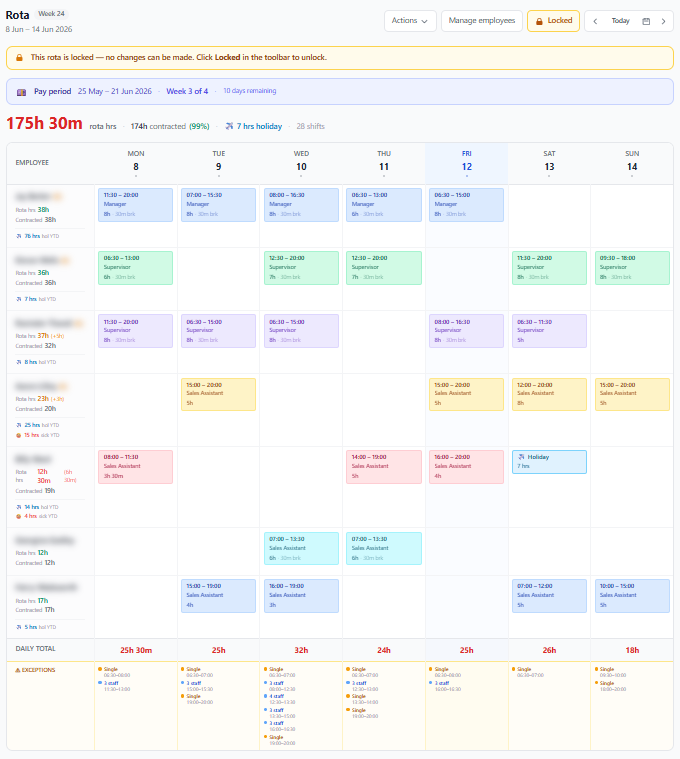
Weekly rota builder
Build the week shift by shift, reuse templates, then lock it so it can't be changed by accident.
Contracted-hours tracking
Every employee's contracted hours sit next to what you've rostered, so you can see over- and under-runs at a glance.
Live wage cost
Daily and weekly wage totals update as you build, per store — see what a rota costs before you commit to it.
Payroll export
Turn the locked week into a payroll export instead of retyping hours into a spreadsheet.
Staff portal
Each employee logs in to see their shifts, holiday left, and to request time off from their phone.
Holiday tracking
Entitlement worked out for shift workers on a rolling 52-week average, with requests and approvals built in.
Rota gap alerts
A weekly nudge if the next three weeks aren't locked, so a forgotten rota doesn't become a Monday-morning scramble.
Shift task lists
The day's jobs land on whoever's on shift and get ticked off in the app — the rota drives the work, not just the hours.
Why this one’s different.
I’m Paul. I run an independent convenience store, and before that my business partner and I ran a 23-store group for private-equity investors — so I know what a proper head office gives you, and I know what doing the rota on a Sunday night feels like when none of that exists at your size.
The rota tools I could buy either did the grid and nothing else, or cost more than they saved, or were clearly built by people who’ve never cashed up on a Friday. So I built my own. The wage cost is there because I wanted to know what a week cost before I committed to it. The staff portal is there because I was sick of holiday requests by text. The gap alert exists because I once forgot to do a rota.
Nothing on this page is a mock-up. It’s what ran my shops this morning — and my partner’s three stores too. Four shops, every day, two separate businesses, one system.
Common questions
Is RetailAce rota software made specifically for convenience stores?
Yes. It was built to run a working convenience store and now runs four of them every day. The rota handles the things shop rotas actually need — part-time staff on varied hours, contracted-hours tracking, wage-cost totals as you build the week, and a payroll export at the end of it — rather than being a generic scheduler adapted to retail.
Can staff see their rota and request holiday from their phone?
Yes. Each employee gets a login to a portal where they can see their upcoming shifts, check how much holiday they have left, and request time off. Requests come to the manager to approve, so shift changes stop routing through phone calls and texts.
Does it work the wage cost out for me?
It totals contracted and rostered hours and shows the wage cost as you build the week, per day and per store, so you can see what a rota costs before you commit to it rather than finding out on the payroll run.
How many stores can it handle?
It runs four stores today across two separate businesses, each with its own staff, rotas and payroll, from one system. It's built multi-store from the ground up, not bolted on.
How do I get it for my shop?
Email Paul at paul@kpmconvenience.co.uk. It goes straight to a retailer, not a sales team — there isn't one. Tell him about your shop and what's eating your time and he'll reply himself.
Want it running your rotas?
Email me. It goes straight to me, not a sales team — there isn’t one. Tell me about your shop and what’s eating your time, and I’ll reply myself.
paul@kpmconvenience.co.uk